Case Study
Raijin is a rewards platform where users earn prize entries by completing tasks in partner-run campaigns. Assets for each campaign could either be produced by internal designers or external partner-side designers.
Raijin’s partner pipeline grew from a handful of campaigns to 40+ external partners shipping concurrently. Every campaign needed custom asset work, and that work was breaking down at handoff.
Three parties were involved: BD (who owned the partner relationship), our internal design team, and partner-side designers we’d never met. None of them had a shared way to talk about what “correct” meant.
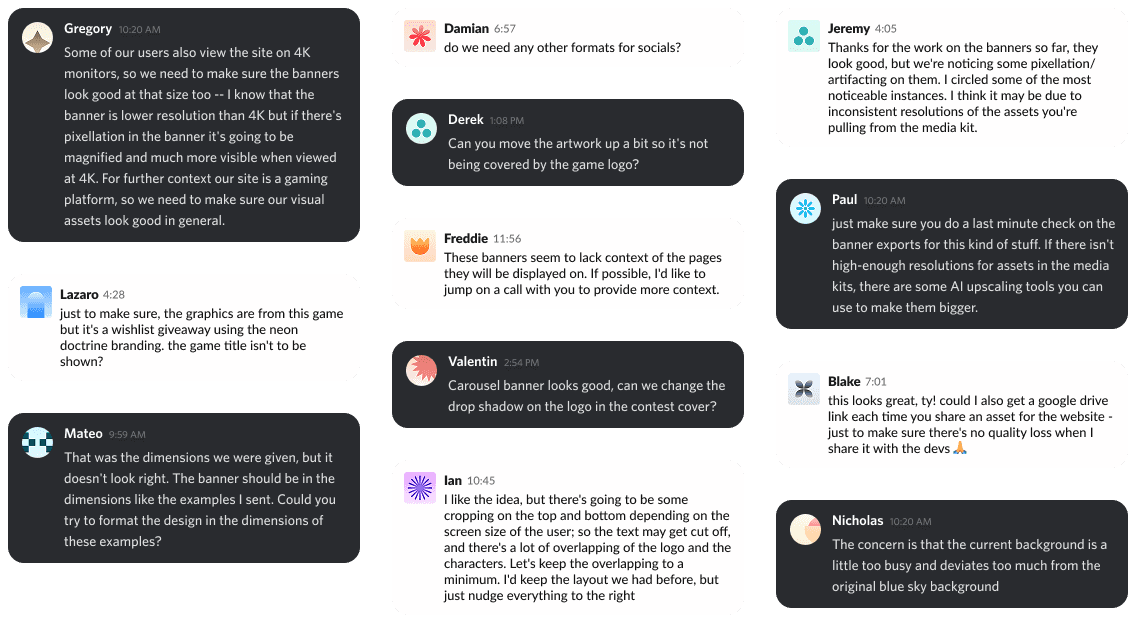
Anonymized messages from our communication channels we used to coordinate campaigns. Before going live, we’d have many rounds of back-and-forths on file formats, resolutions, image quality, branding, cropping concerns, and sharing permissions.
Partner success managers were the main interface between partners and our team, but they weren’t designers. They didn’t have the expertise to pass through clear design specs or requirements. As a result, we’d get assets that we couldn’t use due to incorrect sizing, safe zones, quality, or formats.
When we did the work in-house and sent it over to the partners to be proofed, they’d push back with changes that sometimes didn’t conform to the platform requirements. We’d have to negotiate back, and this could go on for a couple of rounds, creating more unnecessary friction.
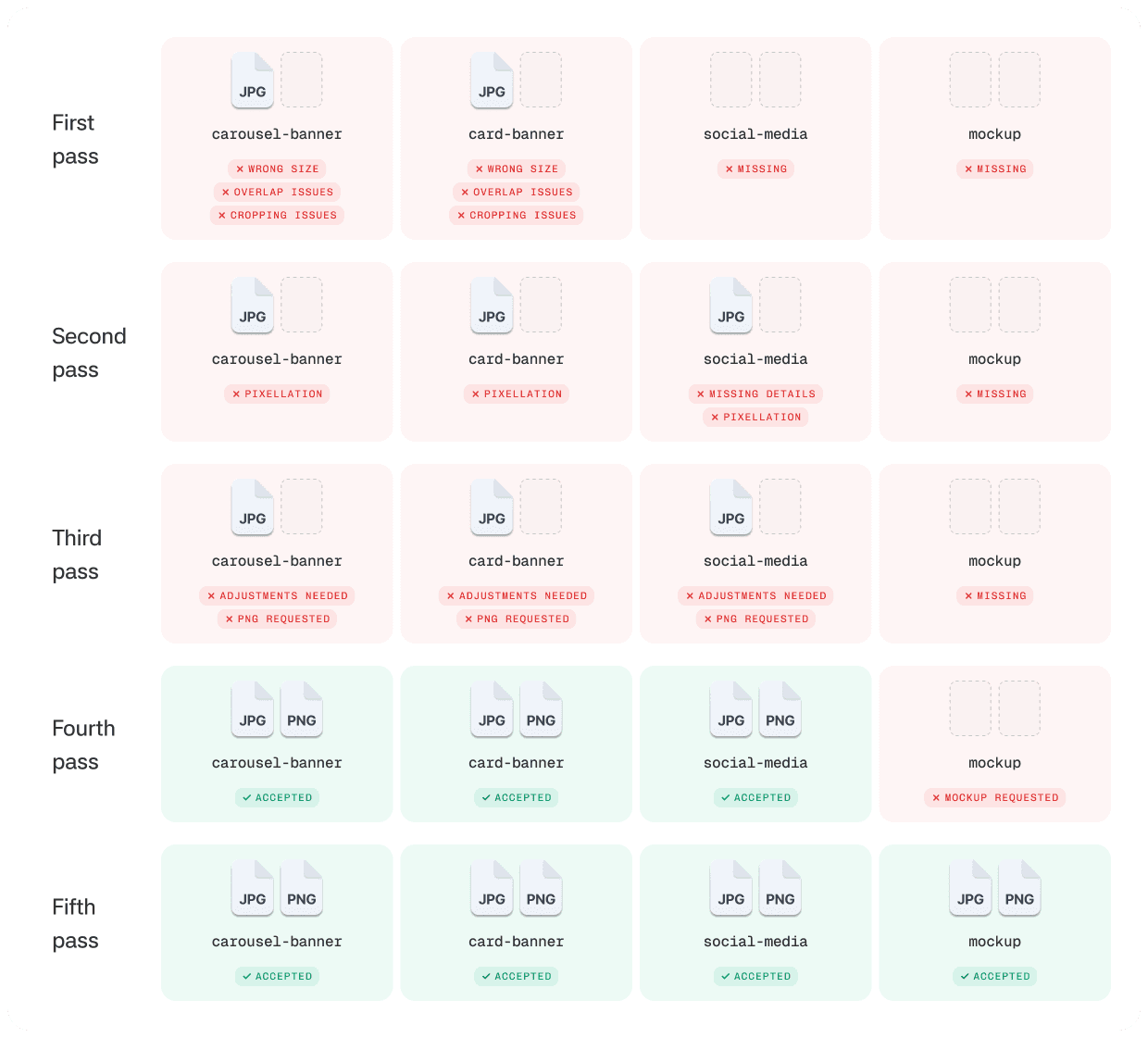
Example of what a campaign asset delivery cycle used to look like: five rounds of revision for four deliverable types in two file formats. Multiply that by 40+ partners.
I created a Notion doc that housed every spec and requirement in exhaustive detail, and updated it constantly. BD and Marketing could send the same link to every partner, and know for certain that it was up-to-date.
It contained working examples for each deliverable: what not to do and why, examples of what you should do, and diagrams showing safe zones and danger zones. It had links to pre-built Figma and Photoshop templates that any designer (on our side or their side) could use to produce assets that were up-to-spec.
Additionally, to shorten the proofing cycle, I included Figma and Photoshop mockup templates that designers could easily drag and drop their assets into to see how it would look on the platform in production, thus cutting more unnecessary negotiations.
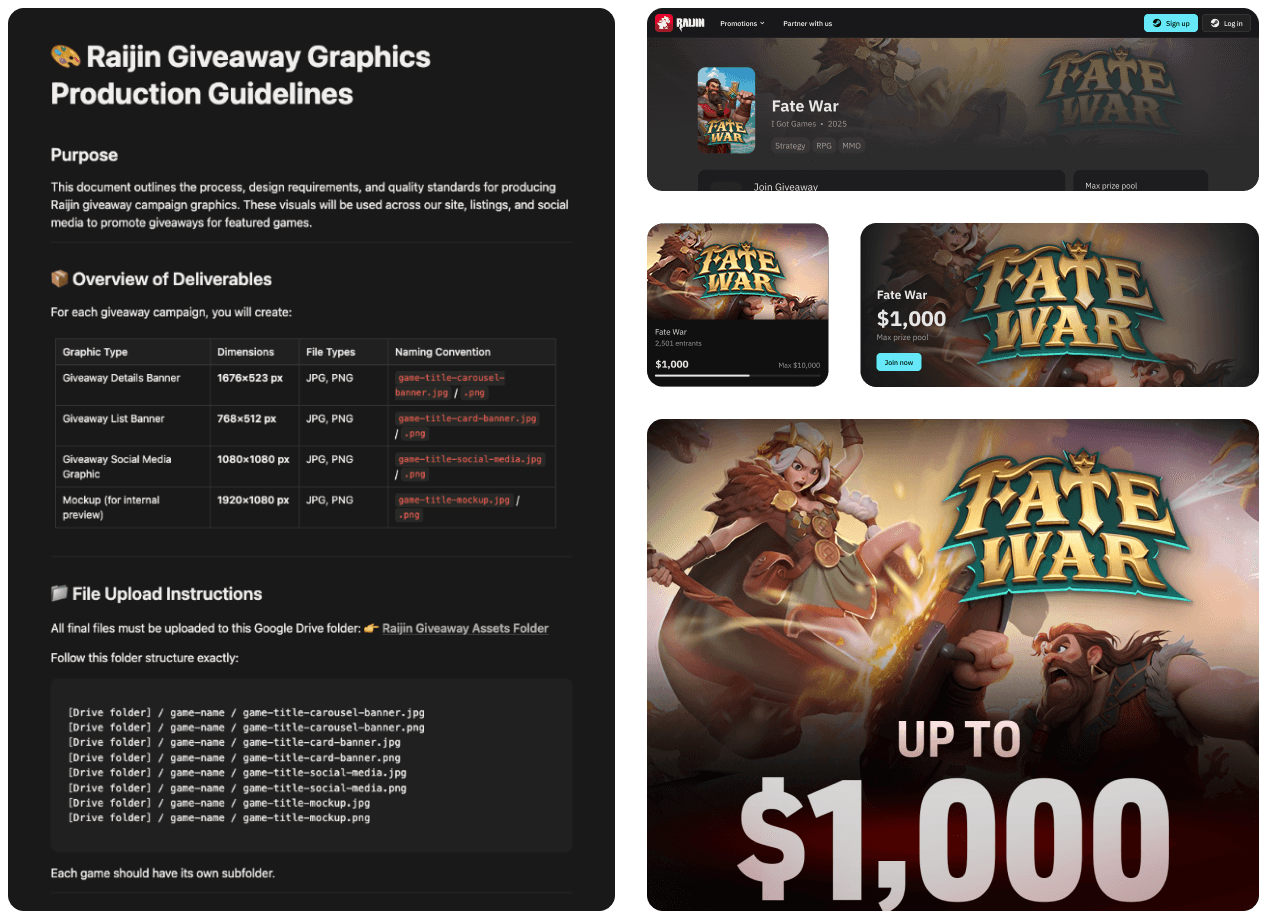
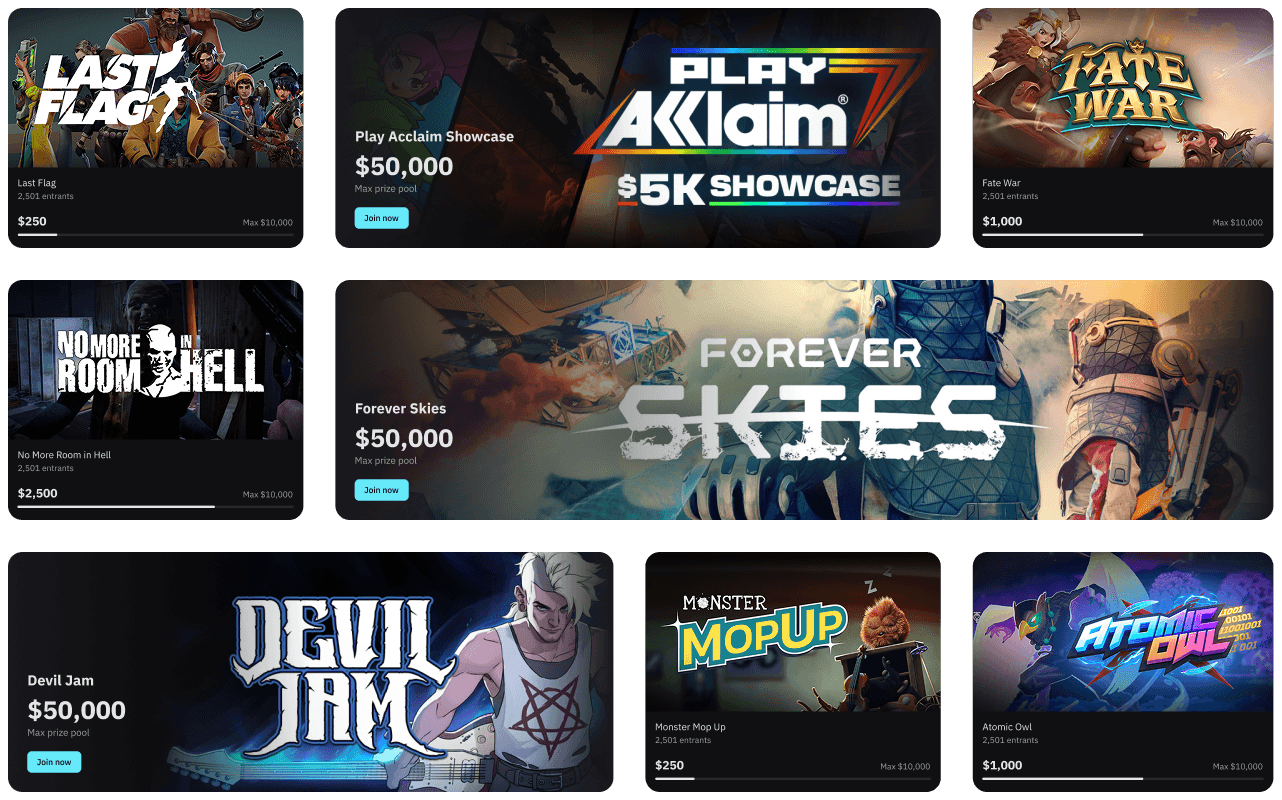
On the left: the unified Notion spec. On the right: an example of some assets provided, and some mockups of how they were used for the campaigns. I also provided Figma and Photoshop starting templates in case they wanted it.
The campaign asset creation pipeline was previously becoming unmanageable under a growing mountain of requests and demands for changes and fixes. This unified Notion spec almost instantaneously fixed that. Asset creation chaos faded into a steady, quiet background noise, even as our system scaled to 40+ external partners. What was once a giant headache and blocker became a process that was as easy as sending a link.